
PAINTINGS FROM ACROSS THE STREET | AUGUST 2026
The Little Street
Despite the quiet solitude of his paintings, Vermeer had eleven children, none of whom are pictured in his work, one more piece of evidence that art is often the reprieve from one's life. He was supported by his wealthy mother-in-law, in whose house he lived and painted. Anton Chekov, who was a physician, famously said in a 1888 letter "medicine is my lawful wife, and literature is my mistress,” which sounds like mere rhetoric when you consider that Paul Gauguin actually left his family and moved to Tahiti in 1891 and began consummating with his numerous nubile subjects, their olive green skin forbidden and otherworldly.
I saw my first Vermeer during an ill-advised trip to Paris, for which I went utterly unprepared and in the throes of various unrequited loves, where I had as close to a mental breakdown as young man in his 20s could have. I gazed into the murky waters of the Seine imagining how my suicide would ruin a date. Exhausted from a sleepless night, I woke up in on a bench inside the Louvre to a little girl staring at a line a drool running down my neck. That night at the hostel, a group of elated Irishmen invited me to go drinking, which I declined, needing to tend to an unnamed obsessive compulsive disorder. I waited for their return all night.
Vermeer doesn’t apply dark paint to paint darkness. He layers translucent glazes of pure crimson, ultramarine, and cadmium yellow on tertiary dark undertones to interplay light’s absorption, an optical illusion—or perhaps manifestation—of darkness itself. The painting no longer represented, but was. That was confusing. Imagine that instead of looking at a cube that has been painted black, being able to look from inside the cube at the darkness inside. The museum guard was not sympathetic to my enthralled nearness to the canvas and shooed me away.
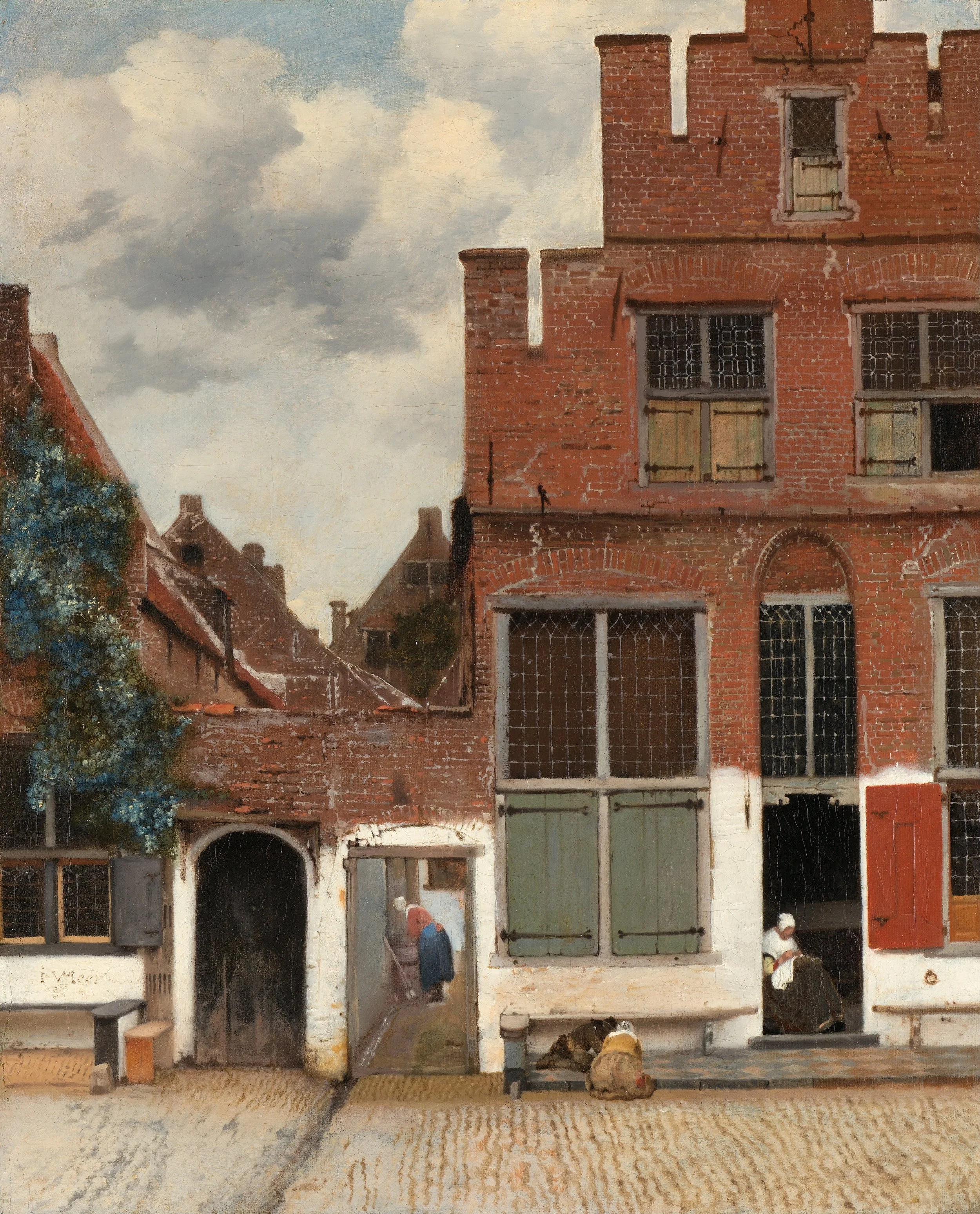
For some unknown reason, amidst the modest number of interior views which would occupy his entire life, Vermeer goes outside and paints a seemingly random and nondescript view across the street in The Little Street (c. 1685), in which women—perhaps the very ones who occupy his interiors—are engaged in humble daily activities.
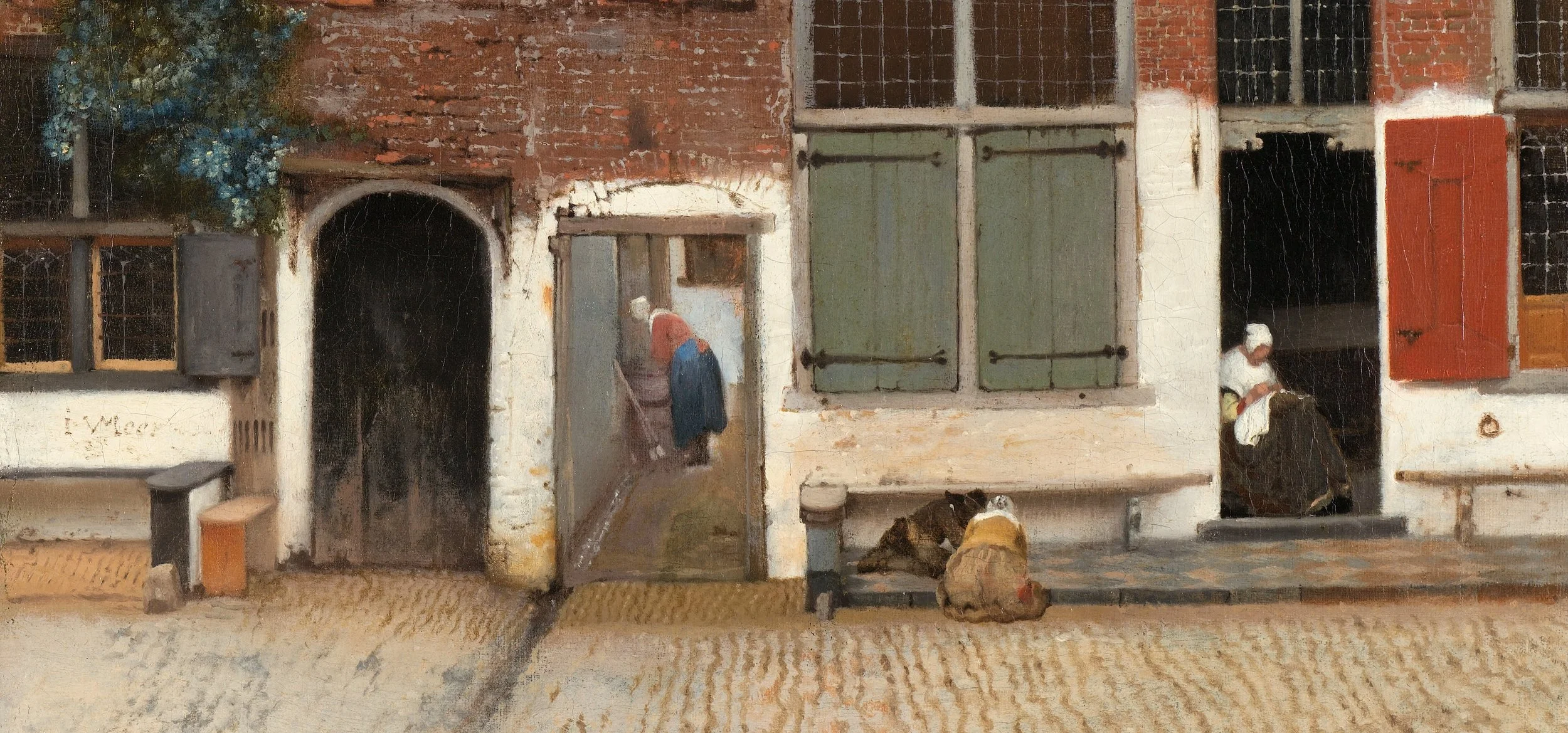
I am probably dreaming too hard, but I like to imagine his mother-in-law driving him nuts that day, emasculating him for being essentially a stay at home dad, and him abruptly leaving the house to get away from her, and making a small discovery which would rattle me centuries later, having been obsessed with the bottom-third of the painting for decades, which has in large part shaped my body of storefront street paintings. The doorways, windows, and alley immediately gain this uncanny presence and the painting becomes about something else—the mystery beyond closed doors, the peak into open ones, the hint of secret lives behind windows.
Paris was the first stop in what should have been a extensive summer trip through Italy to Greece. Listless, idle, and tormented by the expanse of hours allocated for painting I shrunk my life for, I impulsively showed up in the Marias district with unrequited love in my heart and death on my mind. I had this fantasy of waking up naked next to a beautiful woman, a thin cool flatsheet barely covering my relaxed and recently emptied testicles. With what little English she knew, she would give me her address and directions to the nearest train station. I would swallow her face with a final kiss and continue my journey.
Perhaps fantasy is the only genre in art. The entire conceit of marking a rectangle, either by representation or the medium itself, thereby imbuing it with meaning (even a postmodern meaning-ridden void), is an insanely human fantasy. This magic of recognition—to convey to others something as simple as how something looks, or how marks which do not look like anything might make someone feel—remains urgent. I relish in our collective fantasy, this completely obsolete yet somehow incessantly urgent medium. It’s etched in my heart, a kind of grief for a place I’d rather be. Not across the ocean, but across the street ■