
PAINTINGS FROM ACROSS THE STREET
Home Is Were The Hard Is
Paul Gauguin famously lived with Van Gogh until an explosive falling out which concluded in the latter giving a prostitute his newly severed ear. A lesser known detail I find endearing is that he asked her to care for it, as if he had plans to retrieve it.
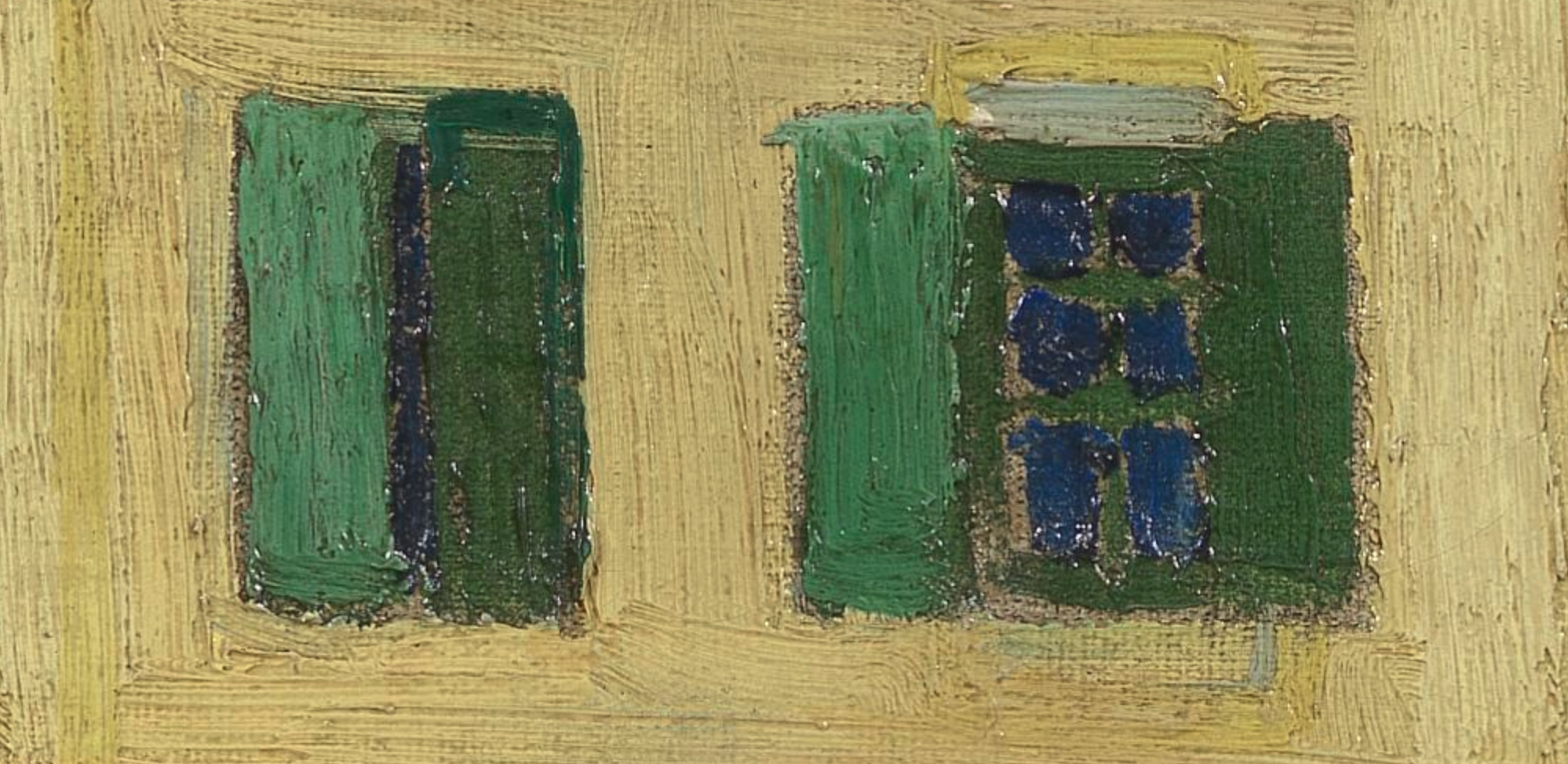
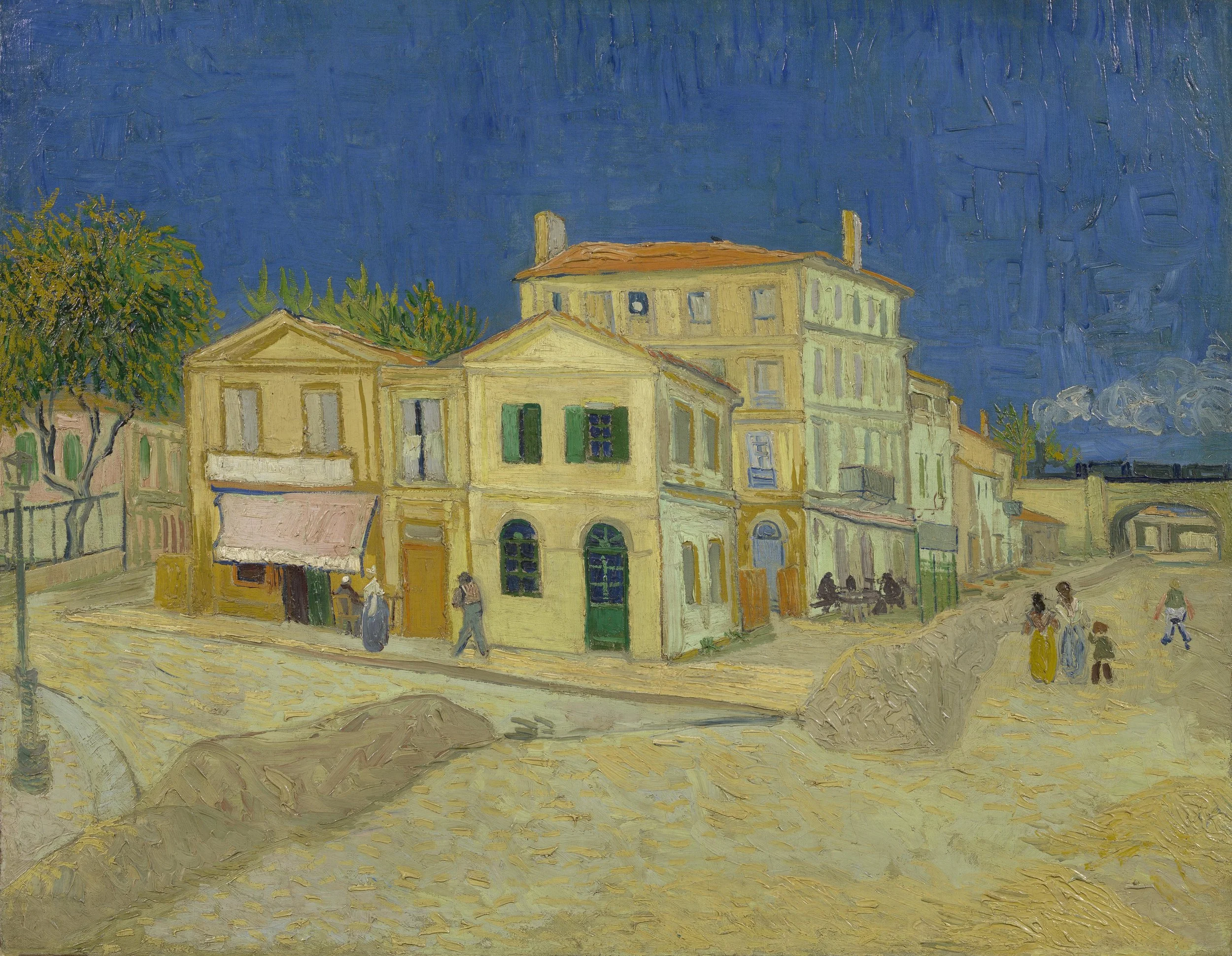
The painters had met, gotten along well, and wanted to start an artists commune in Arles. Their respective bedroom windows can be seen in The Yellow House (1888), in which Van Gogh’s shutters are closed and Gauguin’s are somewhat symbolically wide open, perhaps to let the light in, or for the devil to take him. Soon he would move to Tahiti, leaving Van Gogh with the house to himself and idle hands to paint away, included his bedroom three times, the second to replace the first, which had been water damaged from a leak, and the last one as a gift to his sister, for which he thoughtfully hung her portrait above his bed so that it could appear in the painting.
Before becoming a painter, Van Gogh was a preacher in a coal mining region in Belgium, but his practices where deemed fanatical and unsound. He gave away his money, food, clothing, and smeared coal on his face to share in the suffering. After refusing to tone it down, and calling church leaders hypocrites for asking him to, they let him go. After that, he fell into a dark depression.
One considers what he might have been diagnosed with today, and what a relief some antidepressants would have given him. Selfishly, we ask ourselves if his work would have suffered, if the tight psychosis of his marks would have softened.
In the distance going north towards Paris, a train spews clouds unskillfully painted with cloud-like motions, the way a child might. This is what I love about Van Gogh the most. He paints with naive wonder, but under the catharsis of adult agony. We are left with paintings which do not require understanding nor interpretation, but simply signal to us a tenuous urgency which finds relief in being painted. Here, truth is not revealed; rather, the burn of living is soothed by the balm of paint.
Van Gogh will end up at an asylum in under a year and end his life in the next by shooting himself in the stomach, which was either a masochistic way to prolong his dying, or he simply wanted a chance to live, someone or something to save him. Like his ear, he had plans.
-
Description text goes heresdfsdffsdfsdsdfsdfsdfsd
-
Description text goes heresdfsdsdfsdfsdfsdfdsf
-
Description text goes here
“You are no Van Gogh.”
He paints with naive wonder, but under the catharsis of adult agony.
For Henry James, fiction had in short not one window but a million, referring the the kaleidoscopic labyrinth of thoughts and feelings by which his characters were burdened, to the reader’s delight.
Where doors are meant to be entered, windows are only ever seen. They are inextricably tied to the gaze. Unlike the male gaze, the one through a window is void of possession. It is infinitely curious.
Van Gogh paints Gauguin’s window with the same blue as the sky, as one would with reflections; or, is he making them recede by the dark paint; or, perhaps this is an evasive act, embarrassed by the events inside the house. Already disillusioned with Parisian life, the last thing Gauguin had patience for was a crazy housemate. Their friendship ended that night.
My first son is named after Vincent’s brother Theodore, the loyal worrier who read his brother’s ramblings, bought all of his paintings essentially as charity, and in just 6 months died after Vincent did.
Theo loves to draw but is an intense self-critic. If only he knew that is a problem all thoughtful artists carry. In fits of rage, Monet and Cezanne destroyed their canvases. So when a classmate said his drawings weren’t good, or weird, or messy, he almost gave up entirely. I kneeled before him, desperately bringing up Cy Twombly and Joan Mitchell on my phone to try to reorient the way he judges his own work. I told him art, like life, is not about being right. It’s about quietly standing beside your truth.
I was young and dumb, terribly lonely, and convinced that my vindication would one day materialize on the walls of museums. A man of few words, my father chose his precisely, suddenly, and without charm. At the height of my arrogant fatalism, which I mistook for my hero’s personality, he blurted out “you are no Van Gogh” in the car after picking me up from the train station. I must have been droning on about myself.
If you cannot find an ally in your family, then who can you find? An only child, a brother seemed impossible, so I grew a narcissistic monster in the form of a conjoined twin at my hip. I limped down the avenues with him at my side, terrified by the very world we tried to paint. We got rained on. Dusk swallowed our palette into darkness. Passerbys passed by, smirking at our gall. En plein air plain sucked.
I told Theo that the girl who said his drawings were bad was a petty moron, not unlike her parents probably, and in a flare of bias, that he was a brilliant artist. Probably not the best parenting, but if Theo is to be an artist in this word—a world that lets genius suffer under a misguided capitalist notion that the best will surface to the top, and only then be appropriately lauded by the very class that derided it—then feeling great about yourself may be the only place to start. The world will teach you otherwise, your ego will be annihilated, and whatever is left of you will be your art ■